
“These are my plans: to make a name in science, to make a name in literature
and thus, to raise my race; Or perhaps to raise a visible empire in Africa,
thro’ England, France or Germany. I wonder what will be the outcome?
Who knows?”
— W.E.B Du Bois, Quarter Centennial Celebration of My Life, February 23, 18931
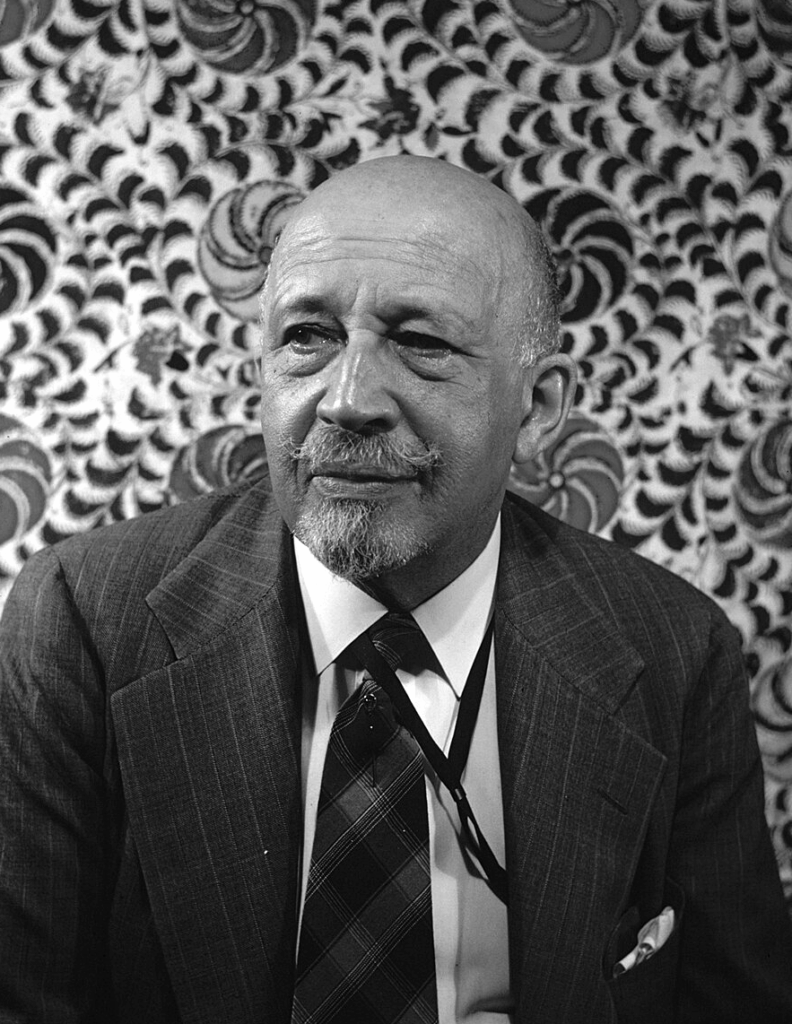
A sociologist, historian, writer, and activist, W.E.B. Du Bois (1868-1963) spent his life studying how race and power shaped the world. Du Bois was the first African American to earn a Ph.D. from Harvard and a co-founder of the NAACP, as well as a relentless advocate for civil rights and global justice.
While he is often remembered for The Souls of Black Folk (1903) and for Black Reconstruction in America (1935), Du Bois’s intellectual reach was far broader. He traveled widely and built networks with activists and leaders around the world. Through Pan-Africanism, a movement for unity and liberation among people of African descent, he connected civil rights struggles in the U.S. with anticolonial movements in Africa and Asia.
Du Bois’s political vision evolved steadily across his lifetime. By the 1930s and 1940s, he had embraced socialism as a way to link racial justice to broader struggles against economic and colonial oppression. His critiques of capitalism and U.S. foreign policy estranged him from the African American political establishment. When he joined global campaigns for peace and disarmament, the U.S. government investigated him and restricted his travel. These pressures culminated in his expatriation to Ghana in 1961, where he lived until his death in 1963. Cold War hostility and McCarthyism consigned Du Bois’s visionary analyses of race and empire — work that anticipated debates on decolonization and global justice — to neglect.
Yet, Du Bois believed that knowledge was a tool of liberation, and he used scholarship, journalism, and data visualization to challenge racism, empire, and capitalism alike. His vision of Black freedom as inseparable from global struggles for justice continues to inspire, and the Global Du Bois project recovers and extends this global legacy.
Notes
- W. E. B. Du Bois, Quarter Centennial Celebration of My Life [fragment], ca. February 23, 1893, W. E. B. Du Bois Papers (MS 312), Special Collections and University Archives, University of Massachusetts Amherst. ↩︎